


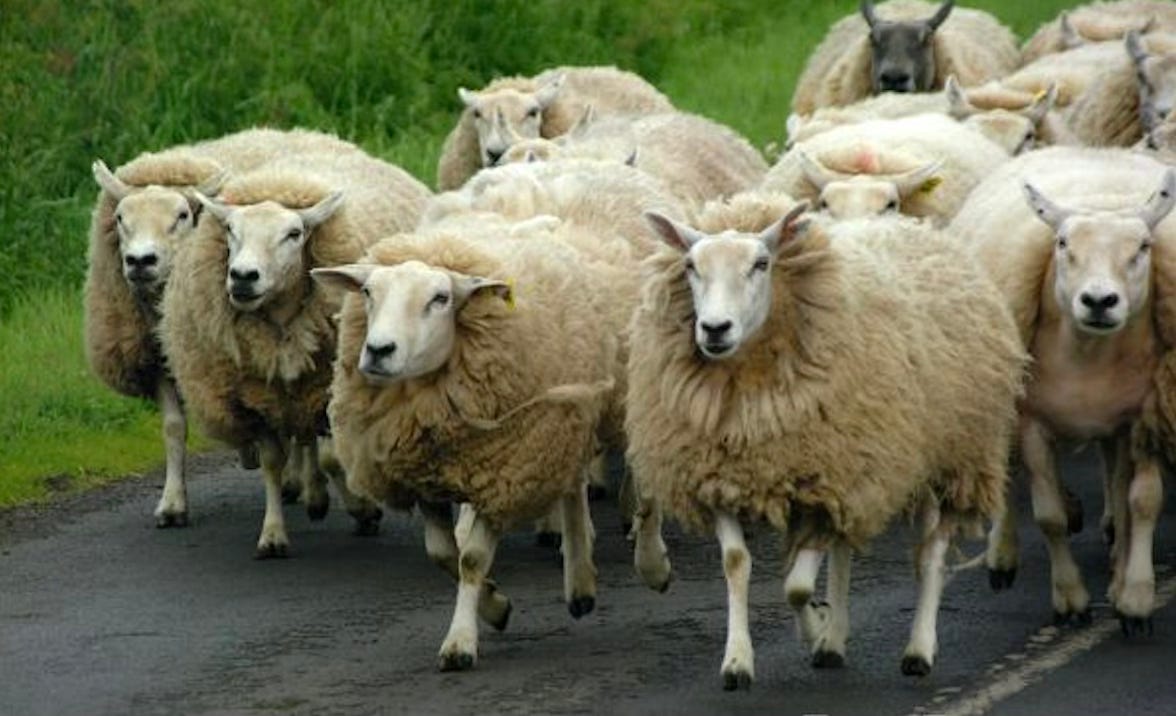
We love the herd when it helps us feel strong. We hate the herd when it makes us feel weak.
Can you just have the strong part?
Alas, it never works out that way. You end up feeling weak for 3 reasons:
Your herd keeps telling you that the other herd is extremely dangerous.
Your herd threatens to leave you behind if you don’t follow it constantly.
Your herd has a social hierarchy and some of your own herd-mates are scary.
So you feel bad if you stick with the herd and you feel bad if you leave. You think a better herd will solve the problem, but it doesn’t. You wonder what went wrong.
The simple answer is unrealistic expectations.
We have been taught that other people should support us. You’re told that you should “feel supported.” Alas, the world disappoints the expectation of “unconditional support,” and disappointment triggers cortisol.
You see the cortisol as a real threat becuase you don’t know that you created it with unrealistic expectation. You can stop the cortisol by replacing those warm, fuzzy beliefs with realistic expectations. Here are 3 examples of realistic expectations.
Animals only follow the herd when it benefits them.
You have been trained to believe that animals have the sense of community that we are looking for. The truth is that mammals only run to the herd when they sense a threat. They prefer to go their own way because that leads to healthier food. But when they sense a threat, they rush to hide behind others to protect themselves. Mammals cooperate when it benefits their own genes, like baboons joining to protect their children from lions. If you think you are above such self-interested calculations, you end up with a lot of cortisol.Unconditional support is for babies, literally.
We are born crying because we can feel needs but we can’t do anything about it. Crying brings support that meets our needs, and that wires us to meet needs by seeking support. But a species could not survive if the young didn’t learn to tie their own shoes and cut their own meat. Each brain must learn to trust its own survival skills instead of just expecting support. But the urge to seek support remains a huge neural pathway so we still flow there easily. It only gets worse because as you mature, you become more aware of the threats in the world. Our brain is not designed to make you “feel safe.” It’s designed to promote survival.People who tell you to expect “support” are selling something.
Maybe they’re selling therapy. Maybe they’re selling themselves as a romantic partner. Mabye they’re selling a political agenda. Maybe they’re selling a product with a warm, fuzzy image. Maybe they’re looking for a drinking buddy. In each case, they benefit when you accept the warm, fuzzy paradigm, but you do not benefit.
Fortunately, you have a choice. You can build realistic expectations instead of being endlessly disappointed. You can be realistic whether or not the people around you are.
I created a free 6-week workshop on the mammalian herd impulse to help you do this. It starts on Jan 24. Details are here. Come and celebrate our biology instead of living with cortisol. You will learn to trust your mammal brain’s ability to choose when to follow the herd and when not to follow.
To get you started, here’s a free pdf of my book,
I, Mammal: How to Make Peace With the Animal Urge for Social Power
For more about the selling of the warm, fuzzy paradigm, check out my book,
Why You’re Unhappy: Biology vs Politics
For more on your power to build realistic expectations, check out my book:
The Science of Positivity: Stop Negative Thought Patterns By Changing Your Brain Chemistry

Our verbal brain romanticizes the herd impulse with abstractions like “bonding” and “togetherness.” When your group mates look for their own benefit, it feels like something has gone badly wrong. You feel like you’re giving more than you get. It’s hard to see that you are looking for your own benefit. But when you see it, you stop feeling like something has gone wrong!
Our mammal brain rewards us with oxytocin when we get protection from others. It rewards us with serotonin when we see ourselves in the position of strength. It rewards us with dopamine when we see an opportunity for new rewards. We love herds because they help us meet these mammalian needs. But it’s realistic to remember that everyone else is trying to meet these needs.
It’s not easy being a big-brained mammal!
FYI: The workshop will not have political partisanship. We will use apolitical examples to explore what is common to all of us. We will not talk about which herd is worse or “who started it.” No herd will be bashed as the “bad guys,” but no herd will be enshrined as “the good guys,” as much as you might want that. I hope to see you there.


